
CDOFAC Charter: The Code of Ethics for Civil Aviation Training Organizations
Flight safety, financial stability, transparency toward students, instructors’ working conditions, and respect for the environment: the CDOFAC Charter (Code of Ethics for Civil Aviation Training Organizations) ensures that a flight school or flying club upholds its commitments. Supported by the DGAC, it is administered by ESTRADS Certification, which verifies each response against supporting documentation and awards a Bronze, Silver, or Gold rating.
Choosing a flight school or flying club:
—what the charter verifies for you
Becoming a pilot takes years of hard work and, when it comes to professional training, a financial investment that is often funded by a loan. Before committing, a prospective student and their family want to know if the school is reliable, if it will still be around by the end of the program, and if it is being truthful about what it offers.
The CDOFAC Charter addresses these questions. A certified organization has demonstrated, with supporting evidence, that:
- that safety is its top priority, both in the air and on the ground;
- that his or her legal, administrative, and professional status is in order;
- that its financial management is sound, so that its students can complete their education;
- that he provide his students with accurate and complete information;
- that it assesses candidates' qualifications before hiring them and supports their success with respect;
- that it provides its instructors and employees with good working conditions;
- that it fits into its human and social environment and minimizes its impact on the environment;
- that it uses up-to-date technical and organizational solutions;
- that he listens to criticism and strives to improve.
Certified organizations are listed, sorted by level, on the page Our Referencespage.
A charter created at the request of the DGAC
The Directorate General of Civil Aviation (DGAC) has come under scrutiny from the press, the public, and industry professionals following management failures at certain pilot training organizations, which have had serious human and financial consequences for their students. The DGAC monitors the schools’ regulatory compliance; it has encouraged the industry to adopt a system that also certifies their quality, ethics, and financial stability.
It is in this context that the DGAC held discussions with ESTRADS Certification, which developed the CDOFAC Charter. The DGAC supports this initiative:
- Its website links directly to the list of CDOFAC-certified ATOs for professional pilot training, sorted by level;
- It references the CDOFAC Charter in the guide “Becoming an Airline Pilot” that it publishes.
The charter remains a voluntary initiative. It supplements the regulatory requirements of the DGAC and EASA, without replacing them.
Professional Flight Schools (ATO)
An ATO (Approved Training Organization) trains professional pilots on airplanes, helicopters, or in simulators: commercial pilot license, instrument rating, and airline transport pilot training. Its students incur significant expenses—often through loans—over several years.
For an ATO, the charter provides three things.
A point that has been verified in front of the students and their families
Families compare schools. An accredited school can demonstrate that an independent third party has verified its safety, finances, and data integrity, and that its accreditation status appears on a list linked to on the DGAC website.
A stronger case with the banks
Banks finance student loans and the school's development. Financial management overseen by a third party provides reassurance to both parties.
An Assessment of the School from an Outside Perspective
Banks finance student loans and the school's development. Financial management overseen by a third party provides reassurance to both parties.
What Certified Organizations Say About It
Flying Clubs
An aviation club trains private pilots, introduces young people to flying, and keeps an airfield running—most often thanks to volunteers. It has many stakeholders: members and students, families, volunteer instructors, the airfield manager, the local municipality and nearby residents, the aviation federation, and the insurer.
The CDOFAC Charter is tailored to the realities of an association. It helps an aviation club document what it already does well—first and foremost, its safety culture—identify areas for improvement, and showcase these efforts to its supporters: local governments, partners, and prospective members. The charter sign, displayed at the club, serves as a reminder to everyone of the commitments made.
Les Ailes du Maine, which has been certified at the Bronze level, and the Sarre-Union Regional Flying Club, which has advanced from Bronze to Silver, are among the certified flying clubs.
"An opportunity to see our flying club in a new light"
Diane Lang is the president of the Sarre-Union Region Flying Club (ACRSU), founded in 1964. The flying club earned the Bronze-level CDOFAC Charter on its first evaluation and is now certified at the Silver level.
“When I discovered the CDOFAC approach, I quickly wanted to get the ACRSU involved. Not just to obtain certification, but because I saw it as an opportunity to look at our flying club in a new light. […] We had many best practices, a genuine safety culture, and values to which we are deeply committed. But as in many organizations, we sometimes did things instinctively—because they seemed obvious to us—without necessarily taking the time to formalize them, measure them, or ask ourselves if we could do better.”
[…] Some answers were already there. Others led us to write, organize, post, modify, or launch new initiatives. […] I particularly appreciated that this wasn’t a rigid or purely paperwork-based certification process, but rather an opportunity to exchange ideas, question certain expectations, and move forward with an outside perspective that pushes us to improve while respecting the reality of a community-based flying club.
[…] "I see it more as our first step than as our finish line."
Diane Lang, President of the Sarre-Union Regional Flying Club
The full testimonial is on the page Testimonials.
Other aviation training organizations
The charter is open to all training organizations in the sector: registered training organizations (DTOs), ultralight aircraft (ULM) flight schools, gliding centers, aircraft maintenance training organizations, and training programs for cabin crew and ground staff. The questionnaire is tailored to each type of organization.
What the CDOFAC Charter Covers
More than 200 criteria, grouped into nine themes and tailored to the type of organization:
- Safety: The organization is familiar with and follows the most up-to-date safety regulations, and continuously monitors compliance with them.
- Legal, Administrative, and Professional Framework: The organization complies with regulations and the principles of business ethics.
- Financial Management: Sound financial management that protects the organization from unforeseen circumstances and ensures that its students can continue their education.
- Transparency: Accurate and comprehensive information for students and applicants.
- Focus on students: aptitude tests before enrollment, monitoring of progress, an atmosphere of respect.
- Focus on employees: working conditions for instructors and staff.
- Human and Social Environment: Relations with the airfield, the municipality, and local residents.
- Environmental protection: noise, fuel, waste, and modern methods for reducing environmental impact.
- Continuous improvement: collecting feedback and criticism, and responding to them.
The criteria are reviewed annually to keep pace with changes in regulations and practices.
Watch the video to learn about the CDOFAC charter!
How do I obtain the CDOFAC certificate?
- The organization completes its application, agrees to the terms and conditions, and receives its login credentials.
- He is filling out the online questionnaire.
- He forwards the requested documents and certificates to the analysis department atESTRADS Certification, which verifies them.
- ESTRADS Certification conducts the on-site inspections required for their level.
- The certification committee, which meets weekly, assigns the level.
- The organization receives its certificate and a communications kit: logo, diploma, and certificate.
- The organization displays the charter poster on its premises, which outlines its key commitments and includes a QR code. Students, families, instructors, and employees can use it to send feedback—whether positive or negative—regarding compliance with the charter to ESTRADS Certification . View the reporting form.
Details are on the page The certification process, in the section on charters.
Bronze, Silver, or Gold
An organization is awarded one of three levels based on its responses, the evidence it provides, and the audits conducted. The levels are not awarded in order: an organization can achieve Gold status as early as its first evaluation. An organization can also advance from one year to the next: ACRSU, which was initially certified at the Bronze level, is now at the Silver level.
- On-site inspections are random for the Bronze and Silver levels.
- They are mandatory for the Gold level.
- The certificate is valid for 12 months. Each year, a new evaluation determines the level, which may go up or down.
The paper document is valid for 3 months and is updated and reissued during its 12-month validity period, so that the certificate presented is always current. The three ways of expressing a result on ESTRADS Certification (levels, index, medals) are compared on the page Levels.
Two key organizations in the industry: GIPAG and SFMA
GIPAG
GIPAG has made the CDOFAC Charter the membership requirement for its new members: any aviation training organization wishing to join the consortium must be CDOFAC-certified. It is the first consortium to have entrusted this verification process to an external certification body. More broadly, when ESTRADS Certification administers the charter of a consortium or professional association, training organizations certified under that charter also benefit from the CDOFAC Charter.
The SFMA
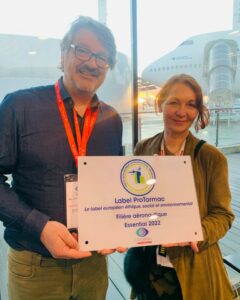
The Aviation Training and Careers Fair (SFMA), held at the Air and Space Museum in Le Bourget, brings together schools, training organizations, and employers each year to meet with young people who are deciding on their career paths. The fair offers the CDOFAC Charter to the training organizations exhibiting there, along with preferential rates that it has negotiated on their behalf. This allows visitors to identify certified organizations. The SFMA itself is certified at the 2-star level of the ProTarmac Certification and the ProDemos Certification.
Be seen by prospective students
A certified organization is highlighted:
- on the list of certified organizations, sorted by level, to which the DGAC website links for ATOs;
- on the page Our References fromESTRADS Certification ;
- on the websites of the partner organizations of which it is a member, such as GIPAG;
- inESTRADS Certification ’s interviews, profiles, and publications: monthly newsletter, press releases, social media, industry trade shows, and trade publications.
This announcement is primarily intended for prospective students and their families, followed by journalists, local elected officials, banks, insurance companies, employees, suppliers, and government agencies.
Take It a Step Further: ProTarmac Certification
The charter can be a first step. A certified organization that wishes to evaluate its entire “ ESG ” approach can undertake the ProTarmac Certificationprocess, designed for the aviation industry and airport infrastructure, which features five levels and a comprehensive analysis report. Several training organizations, including Cannes Aviation Academy, Aéropyrénées, and AFMAé, are ProTarmac-certified. For an organization where aviation training is only one part of its operations, the FranceRSE Certification covers all sectors. All certifications and charters are listed on the Our Certificationspage.
As an independent, trusted third party, ESTRADS Certification is an organization that provides verification, ESG ratings, CSR certification, and sovereignty assessments. It has issued 650 certifications and attestations, is certified to ISO 9001, ISO 14001, and ISO 45001, and holds the status of a mission-driven company (see Our Commitments). Documents submitted by training organizations are hosted in France by a provider not subject to the Cloud Act (see Our Sovereignty).
Obtain the CDOFAC Certificate
A quick conversation with the team atESTRADS Certification is all it takes to find out which questionnaire applies to you and what conditions apply, particularly for GIPAG members and SFMA exhibitors. A certified organization that recommends ESTRADS Certification is eligible for the referral program.
The CDOFAC Charter is a registered trademark ofESTRADS Certification.