NSI (National Sovereignty Index) Certification: Measuring an Organization's Sovereignty
Who owns your capital? Where is your data hosted? Which countries do your suppliers, raw materials, and software depend on? NSI certification answers these questions based on more than 200 criteria and translates the results into a sovereignty index out of 100, both overall and by category. ESTRADS Certification calculates the index based on verified evidence, for a single country, multiple countries, or Europe.

What Sovereignty Means for a Company
A sovereign company retains control over its decisions, its data, and its operations, regardless of external pressures. This control can be lost in specific ways: a foreign shareholder acquiring a stake in the company, a lender obtaining veto rights, a sole supplier located outside Europe, software subject to extraterritorial legislation such as the U.S. Cloud Act, or a component that cannot be obtained in the event of a crisis.
Dependencies can be financial, energy-related, digital, technological, industrial, or strategic. They aren’t listed in a marketing brochure, and a flag on a website proves nothing. They are verified through an examination of capital, governance, applicable law, data hosting, and the supply chain. That is what NSI certification does.
Why Measure Sovereignty?
Buyers are already asking questions
Before selecting a supplier, the procurement departments of large corporations and government agencies want to know who controls the supplier, where it manufactures its products, who it reports to, and where it stores their information. This is often a requirement in the defense, security, energy, and healthcare markets. The NSI provides companies with a quantified, third-party-verified response to include in their bids and B2B or B2G transactions.
Investors are looking at resilience
Banks, investment funds, and insurers now assess a company’s exposure to critical dependencies before financing it. An NSI index reassures them of the company’s ability to weather a supply disruption, sanctions, or a takeover. ESTRADS Certification also incorporates the NSI into its ESG rating for banks and funds.
Government agencies want reliable partners
Public institutions and government oversight agencies are placing increasing importance on the independence of their service providers and the security of their supply chains. The NSI demonstrates that your practices are consistent with these expectations.
The company has a clear understanding of its own weaknesses
Calculating the index is, first and foremost, a diagnostic tool. Chapter by chapter, the company can identify its technological dependencies, supplier dependencies, and financial or governance vulnerabilities, and determine which areas to address first in order to improve its index score.
How do you interpret the NSI index?
The NSI does not have levels. It provides a sovereignty index expressed as a percentage, ranging from 0 to 100. There is no minimum threshold: every organization evaluated is certified, with the index it has achieved. The overall index is accompanied by a score for each of the ten chapters, allowing you to see at a glance where the strengths and weaknesses lie.

An index for a single country, for several countries, or for Europe
Sovereignty is measured relative to a reference country. The company chooses from three options:
- an index for a country: for example, 85% for France;
- an index for several countries: for example, 85% for France and 73% for Italy;
- a European index, calculated based on criteria specific to each Member State.
A company with operations in several countries can thus provide each of its customers with the index that applies to them.
A real-world example: the index ofESTRADS Certification
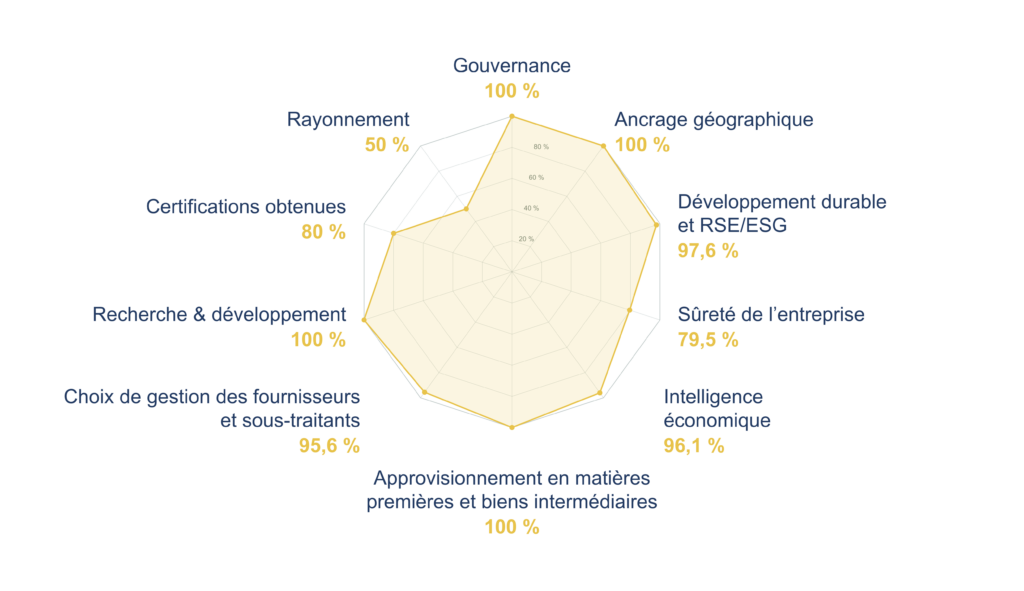
ESTRADS Certification has applied the NSI to its own organization and is publishing the results, chapter by chapter. This is a self-assessment: each response is based on the same evidence required of clients.
Overall score: 90.52%
- Governance: 100%
- Geographic presence: 100%
- Sustainable Development and ESG : 97.6%
- Corporate Security: 79.5%
- Economic Intelligence: 96.1%
- Procurement of raw materials and intermediate goods: 100%
- Supplier and subcontractor management decisions: 95.6%
- Research & Development: 100%
- Certifications earned: 80%
- Radiation: 50%
Details are on the page Our Sovereignty.
An index that is rising
The index is valid for 12 months and is recalculated annually. An organization that changes its hosting provider, diversifies its suppliers, or strengthens its governance will see its index rise at the next evaluation. Conversely, a takeover or the entry of a foreign shareholder can cause it to fall. The three ways results are presented (levels, index, medals) are compared on the page Levels.
What the Certification Assesses
More than 200 criteria, tailored to the type of organization: manufacturing, services, startups, and public institutions. The questionnaire begins with basic information about the company (identity, business activity, number of employees, locations), and then covers ten sections. Each section is assigned a score.
- Governance Policy: Who owns the capital, directly and indirectly? Does the company have debt owed to foreign creditors? A company may have French capital but lose control over its decisions due to debt or a covenant.
- Geographic Presence Policy: Where are the headquarters, production facilities, and teams located? Does the company have subsidiaries or branches abroad? What law governs its contracts, and which courts have jurisdiction?
- Sustainability and ESG Policy: A company that manages its environmental and social impacts, as well as its energy and resource consumption, is less dependent on factors beyond its control. Strong commitments t ESG enable the company to ensure its long-term viability.
- Company Security Policy: Protection of facilities, people, and information; cybersecurity; data hosting; access control; and the exposure of digital tools to extraterritorial laws.
- Economic Intelligence Policy: Monitoring competitors, markets, and threats; managing interference by audit, consulting, or certification firms.
- Policy on the Procurement of Raw Materials and Intermediate Goods: Where do raw materials and components come from? Are there alternative sources? Does the company depend on a single country for a critical component?
- Policy on the Selection and Management of Suppliers and Subcontractors: Nationality, capital, and location of suppliers and subcontractors, extending to Tier 2 and Tier 3 where possible; sovereignty criteria in procurement; business continuity plans in the event of failure.
- Research and Development Policy: Where research is conducted, who owns the intellectual property, where patents are filed, and with which partners the company innovates.
- Certifications obtained by the company: Certifications or awards already held by the organization, whether they relate to quality, the environment, safety, cybersecurity, or the " ESG" initiative.
- Outreach Policy: The company’s role in its ecosystem: participation in professional associations and competitiveness clusters, contributions to the industry, and presence at trade shows and in the trade press.
Who is eligible for NSI certification?
NSI certification is intended for all stakeholders in sensitive and complex industries (defense, security, aerospace, space, nuclear, energy, healthcare, and digital), as well as companies in other sectors that wish to enter these industries. The process is voluntary: any organization may request an assessment.
Contractors and Large Corporations
The NSI helps a large corporation structure its practices to reduce its critical dependencies—whether technological, industrial, digital, or financial. It also provides the company with a common framework for evaluating its suppliers and incorporating them into a year-over-year improvement process. To map its entire supply chain based on supplier certifications: ATLAS.
ETI
In markets where economic, technological, and industrial sovereignty plays a key role in decision-making, the index enables a mid-sized company to stand out from its competitors and facilitates its access to government contracts and major clients.
SMEs
The index shows that an SME is able to maintain its independence and ensure the stability of its operations. This is a key selling point when dealing with industrial, institutional, and financial partners—whether in response to requests for proposals or when engaging with investors who prioritize the company’s resilience.
Startup
Calculating the index provides an assessment of a company’s technological and supplier dependencies, financial resilience, and governance. A startup raising funds can demonstrate to its investors, banks, and early customers that it has addressed these issues.
Professional associations, clusters, and competitiveness clusters
An organization that wants to help its members advance their financial sovereignty can offer them the NSI. Some professional organizations and financial institutions are already encouraging their members and clients to obtain it. These partnerships are listed on the page Our Partnerspage.
Public Institutions
Public institutions, agencies, and local governments can assess their own dependencies—particularly digital ones—and report on them to their supervising authorities and citizens.
A sovereignty index calculated by a sovereign entity
It would make no sense to entrust details about its capital, suppliers, and security measures to an evaluator subject to foreign law. ESTRADS Certification is a SASU (simplified joint-stock company) whose capital is 100% owned by its president, a French national: no foreign investors, no funds, and no parent company. It is not subject to the Cloud Act. Supporting documents and reports are hosted on its in-house developed ARGOS platform, on a dedicated server in France. The details—including what aspects are not under its control—are published on the page Our Sovereigntypage.
As an independent trusted third party, ESTRADS Certification is an organization that provides verification, ESG ratings, CSR certification, and sovereignty assessments. Founded in January 2020, it has issued 650 certifications. It holds the status of “national defense partner company” by decree of the Ministry of the Armed Forces dated June 14, 2021, has held the status of a “mission-driven company” since 2025, and is certified to ISO 9001, ISO 14001, and ISO 45001. It has initiated an accreditation process with COFRAC in accordance with the NF EN ISO/IEC 17029 standard (See our commitments).
Letter of Recognition from the DGA
ESTRADS Certification received an official letter of recognition from the DGA highlighting the relevance of his work. As this excerpt states:
“The Defense Industry Directorate (DGA/DID) has taken note of the work conducted by ESTRADS Certification in the field of ethical, social, environmental, and sovereignty certification as applied to complex and sensitive industrial sectors, and more specifically to strategic sectors related to defense and security. This letter serves as explicit recognition of the value of the approach developed by ESTRADS Certification as an independent private initiative aimed at supporting industrial stakeholders in a proactive effort to advance and structure their practices.”

Calculate Your Index
A quick conversation with the team atESTRADS Certification is all it takes to determine which questionnaire applies to you, for which countries your index should be calculated, and which rate applies. Members of partner organizations receive preferential terms. A certified organization that recommends ESTRADS Certification benefits from the referral program.
The NSI Certification—National Sovereignty Index—is a registered trademark ofESTRADS Certification.