ProTarmac Certification: The " ESG " Certification for the Aviation and Airport Industries
The ProTarmac Certification measures an organization’s social, environmental, and ethical performance within the aviation sector and demonstrates this to its customers, financial backers, and local residents. It applies to airports and airfields, companies operating at airports or serving the aviation industry, as well as public services and public institutions in the sector. As the first European “ ESG ” certification in this sector, it is issued by ESTRADS Certification based on supporting documentation and following an on-site audit.

An airport complex, dozens of organizations on the same grid
At an airport, the airport operator works with ground handling agents, fueling companies, security firms, maintenance shops, freight forwarders, retail businesses, and sometimes a flight school. Each has its own social and environmental practices, and each may be questioned about them by a client, a bank, or a local government.
ProTarmac Certification evaluates all these organizations using a single set of standards, tailored to each organization’s specific activities and size. An airport operator can request that its service providers submit evidence based on the same standards as its own. A service provider submits a single certificate to its clients and uses the same report to respond to the questionnaires ESG it receives.
To track suppliers and subcontractors based on their certifications, a manager can also use ATLAS, the supplier and subcontractor mapping tool.
Why does an organization in the aviation industry seek ProTarmac certification?
Requests for evidence ESG are coming in from several sources.
- Public procurers. As of August 21, 2026, all public contracts must include at least one environmental award criterion and one environmental performance requirement (Article 35 of the Climate and Resilience Act). A contractor bidding on a contract with a public airport or a local government must demonstrate its environmental performance.
- Private clients. Airlines, airport operators, and manufacturers are asking their suppliers about their practices. A certificate issued by a third party provides them with evidence to support these practices.
- Banks, investors, and insurers. They find document-verified ESG data in the certification report that they can use in their own analysis.
- Job seekers—including mechanics, technicians, ground crew, and security personnel—also choose their employer based on working conditions. The qualifications required are listed in a job posting or at a job fair.
The certification comes with a communication kit (logo, plaque, certificate, and messaging guidelines), and your organization will be listed among the ProTarmac-certified organizations.

Who is eligible for ProTarmac certification?
The certification is intended for the entire industry, including both public and private organizations, regardless of their size. The criteria are tailored to each organization’s specific activities and size.
Airports and Airfields
Whether it’s a major regional airport or a general aviation airfield, an airport operates in close proximity to neighboring communities. Around many airports, an environmental advisory committee brings together aviation professionals, local governments, and residents’ associations. The certificate and the assessment report provide a verified basis for presenting to elected officials and residents the measures being taken regarding noise, energy, waste, and biodiversity within the airport’s footprint.
Public Services and Public Institutions
Many airports and airfields are owned by local governments or operated by joint public-private entities, public agencies, or chambers of commerce. Other public institutions are involved in air transportation: training institutions, government agencies, and emergency and security services. A public institution is accountable to its governing body, elected officials, and users. ProTarmac Certification provides an independent assessment of its approach to “ ESG,” using criteria tailored to a public organization, and a report that tracks its progress from one year to the next.
Ground Handling, Refueling, Security, and Cargo
Ground handling, catering, cargo loading and unloading, passenger services, aircraft refueling, and security: Your teams work on the tarmac and in restricted areas—often on rotating shifts—on behalf of the airport operator and airlines. The certification assesses your working conditions, energy consumption, equipment, and waste management, and provides you with a document to include with your responses to requests for proposals. Fuel suppliers are on the front lines when it comes to aviation fuel: starting in 2025, the European ReFuelEU Aviation regulation requires suppliers to deliver at least 2% sustainable aviation fuel to airports in the European Union, rising to 6% by 2030.
Maintenance, Engineering, and Aerospace Manufacturers
Maintenance shops, equipment manufacturers, and Tier 2 or Tier 3 subcontractors: Your industrial clients and companies are asking their suppliers to complete questionnaires such as ESG. The certification report documents your actions, highlights any deviations from the standard, and serves as a standardized response to these questionnaires. Maintenance organizations that wish to first commit to a code of conduct can start with the CDOMAC Charter.
Flight schools and training organizations
Several aviation schools and training centers are ProTarmac-certified, including Aéropyrénées, Cannes Aviation Academy, and AFMAé at the 3-star level. The certification evaluates your policies toward students and staff, your environmental footprint, and your management practices. For organizations that train professional pilots, the CDOFAC Charter, supported by the DGAC, also focuses on the quality of training, the organization’s financial stability, and its ethical standards.
Startups, SMEs, nonprofit organizations, and consulting firms
A drone or aerial mobility startup, a flying club, or a consulting firm does not have the resources or the scope of a large corporation. The criteria are based on the organization’s size: the first level, Essential, assesses the current situation and shows where to start. A consulting firm that already has an action plan— ESG —receives an evaluation tailored to its line of business.
ESG -related issues examined in the aerospace industry
The ProTarmac Certification evaluates an organization against more than 500 criteria, grouped into nine categories. The table provides examples of what is assessed in the industry.
- Internal Policy: Gender Equality, Diversity, Disabilities, Occupational Health and Safety, Continuing Education, Career Management
- High-Demand Occupations: The Appeal of Careers in Maintenance, Security, and Passenger Services; Apprenticeships; and Skills Transfer
- Customers, suppliers, and subcontractors: Shared social, environmental, and ethical commitments with companies and service providers (ground handling, catering, maintenance, security)
- Community Relations: Social interactions on the platform; consultation with local residents, municipalities, and organizations; local engagement
- Environment: Energy efficiency, internal mobility, noise pollution, biodiversity, resource management
- Waste: Sorting, recycling, and treatment of passenger waste, maintenance waste, technical fluids, and hazardous materials
- Responsible Innovation: Electric Mobility, Traffic Management, Sustainable Infrastructure, Research for Lower-Emission Aviation
- Cybersecurity: Protecting Systems and Passenger Data, Raising Awareness, and Training Staff
The framework is based on the international, European, and French documents listed on the page Our Certifications, from which it draws the requirements applicable to aviation professions. It is revised annually.
They are ProTarmac-certified
Flight schools, training centers, airfields, service providers, and manufacturers are among the organizations certified by ProTarmac, ranging from the Essential level to the 3-star level. The complete list is available on the " Our References" page .
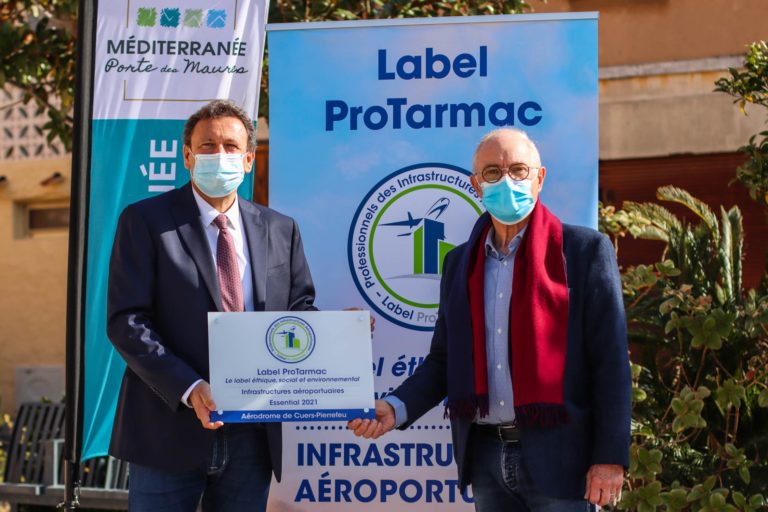
The Cuers-Pierrefeu Airfield, ProTarmac-certified since 2021


A French organization for your sensitive data
During the evaluation, the platform or company submits documents regarding the organization of its sites, its security, and its service providers and subcontractors. For an airport, this information is sensitive. It remains in France:ESTRADS Certification is 100% French-owned, and the company is not subject to the U.S. Cloud Act. The page Our Sovereignty page details these safeguards.
Depending on your line of business, otherESTRADS Certification certifications can be combined with ProTarmac:
- A company that also supplies the military or law enforcement agencies can add the ProD&S Certification, such as La Compagnie des Pyrénées and Titan Défense, which are certified under both ProD&S and ProTarmac;
- To assess a country's level of sovereignty (capital, dependencies, suppliers), the NSI index assigns a score out of 100;
- For its non-aeronautics operations, the FranceRSE Certification covers all sectors.
Partner Aviation Associations
Several industry trade associations have signed a partnership agreement with ESTRADS Certification to benefit their members:
- the UAF (Union of French and Francophone Airports) and the AAF (Association of Airfields of France): services and support offered to their members on preferential terms;
- GIPAG: annual discount on ProTarmac certification for its members;
- the Aviation Training and Careers Fair (SFMA), which is itself a 2-star ProTarmac-certified event: providing specialized support for its exhibitors;
- ASTech Paris Region: A Partnership to Support the Aerospace Industry.
Details about each partnership can be found on the " Our Partners" page .

ESTRADS Certification, an independent certification body
As an independent trusted third party, ESTRADS Certification is an organization that provides verification, ESG ratings, CSR certification, and sovereignty assessments. None of the 650 certifications it has issued has been rejected by a client or customer. Its own practices are certified to ISO 9001, ISO 14001, and ISO 45001, and it holds the status of a “mission-driven company” as defined by the PACTE Act.
ESTRADS Certification received an official letter of recognition from the DGA highlighting the relevance of his work. As this excerpt states:
“The Defense Industry Directorate (DGA/DID) has taken note of the work conducted by ESTRADS Certification in the field of ethical, social, environmental, and sovereignty certification as applied to complex and sensitive industrial sectors, and more specifically to strategic sectors related to defense and security. This letter serves as explicit recognition of the value of the approach developed by ESTRADS Certification as an independent private initiative aimed at supporting industrial stakeholders in a proactive effort to advance and structure their practices.”

Let's talk about your ProTarmac certification
Tell us who you are (platform, service provider, manufacturer, school, or public institution): theESTRADS Certification team will let you know the target level, the timeline, and the fee. A certified organization that recommends ESTRADS Certification benefits from the referral program.
ProTarmac Certification is a registered trademark ofESTRADS Certification