ORSIS, Observatory for the “ ESG ” and Sovereignty of Strategic Industries
ORSIS is the leading annual barometer of the performance ESG, resilience, and sovereignty of strategic sectors in France and Europe.

ESG , and Sovereignty Observatory
of Strategic Industries
What is the Observatory for the ESG , and Sovereignty of Strategic Industries (ORSIS)?
Issues of sovereignty, ESG , and resilience now play a central role in public policy, industrial strategies, and investment decisions.
No sector is spared. But for strategic industries—defense, security, aerospace, naval, rail, telecommunications, chemicals, deep tech, space, nuclear, agriculture, transportation, energy, healthcare—in France, the European Union, and all the sensitive markets linked to them—these challenges take on particular significance: critical dependence on a single supplier, an unmitigated cybersecurity breach, or a poorly mapped supply chain are not merely reputational risks. They are vulnerabilities that directly affect national and European sovereignty.
Yet these sectors are currently managing their performance ESG, resilience, and autonomy without a measurement tool tailored to their needs. Existing data remains fragmented, scattered across systems designed for other sectors, and rarely capable of reflecting the concrete realities of complex and sensitive industries. Strategic companies, the trade associations that represent them, the institutions that support them, and the investors who finance them are thus largely feeling their way in the dark when it comes to these issues.


ORSIS Partners
1. Dissemination partners (federations, clusters, unions, competitiveness clusters, public institutions, etc.)
2. Institutional partners (DGA, ministries, CEA, regions, government agencies and departments, public institutions)
3. Financial partners (banking groups, consulting firms, professional associations, labor unions, competitiveness clusters, regions)
Why was the Observatory for the ESG , and Sovereignty of Strategic Industries (ORSIS) created?
ORSIS was created to meet a growing need among economic, institutional, and financial stakeholders: to provide a reliable, independent, and well-documented overview of the performance ESG, resilience, and sovereignty of strategic sectors. Its mission is to produce useful, objective, and consolidated insights into the evolution of practices ESG, resilience capabilities, and sovereignty issues within strategic sectors in France (defense, security, aerospace, naval, rail, telecommunications, chemicals, deep tech, space, nuclear, agriculture, transportation, energy, and healthcare) and across Europe.
The data collected is analyzed in aggregated and anonymized form to ensure the confidentiality of participating organizations while allowing for the identification of relevant industry trends.
Strategic industries are facing major transformations: increasing regulatory requirements, geopolitical tensions, critical dependencies, recruitment challenges, financing issues and funding for the transition, securing supply chains, the development of artificial intelligence, and cybersecurity.
In the face of these challenges, ORSIS serves as a collective management tool that helps objectively assess situations, identify best practices, and support organizations’ progress.
By supporting ORSIS, partners actively contribute to the development, competitiveness, and resilience of strategic French and European industries.
The ORSIS Indices
Each issue of ORSIS presents a series of indices that measure and compare the performance of various sectors:
defense, security, aerospace, naval, rail, telecommunications, chemicals, deep tech, space, nuclear, agriculture, transportation, energy, and healthcare
Why " ESTRADS Certification "?
Led by ESTRADS Certification, an independent trusted third party that provides verification, ESG rating, CSR certification, and sovereignty assessment services, ORSIS produces an annual, sector-specific, comparable, and well-documented assessment of the maturity of organizations in strategic sectors across five dimensions: ESG, sovereignty, resilience, ethics and compliance, and HR attractiveness. Through its expertise, independence, specialization in strategic sectors, and ability to concretely evaluate organizations based on criteria related to ESG and sovereignty, ESTRADS Certification possesses all the necessary legitimacy to develop and publish this observatory.
The legitimacy of an observatory depends above all on the expertise, independence, and experience of the organization that operates it. In this regard, ESTRADS Certification occupies a unique position in Europe:
- As an independent, trusted third party, ESTRADS Certification is an organization that provides verification, ESG ratings, CSR certification, and sovereign rating services.
- Specializing in complex, sensitive, and strategic sectors, ESTRADS Certification has been working for several years with companies, infrastructure providers, and organizations operating primarily in the fields of defense, security, aerospace, space, nuclear energy, and other sectors critical to national security.
- ESTRADS Certification partners with the leading professional networks in France’s strategic sectors (professional groups, federations, associations, clusters, and influential networks representing several thousand companies and organizations within these sectors).
The work carried out by ESTRADS Certification is based on regular exchanges with leading, highly engaged professional organizations representing thousands of companies, including small and medium-sized enterprises (SMEs), mid-sized companies, large corporations, airports, airfields, training organizations, and institutional stakeholders. - The tools developed by ESTRADS Certification are based on several hundred evaluation criteria covering environmental, social, ethical, governance, compliance, resilience, and sovereignty factors. This methodological expertise enables the organization to rigorously analyze organizational practices and identify underlying trends across these sectors.
- ESTRADS Certification has developed industry-specific certifications tailored to strategic markets (defense, aerospace, nuclear, space, etc.) intended for public and private organizations.
- ESTRADS Certification is based on the founding principles of sovereignty, transparency, independence, robustness, and impartiality, which form the foundation of its evaluation and certification activities.
- This expertise has been recognized by numerous institutional stakeholders.
- ESTRADS Certification is ISO 9001 · ISO 14001 · ISO 45001 certified | Mission-driven company | Partner of the Department of Defense
- ESTRADS Certification is a sovereign enterprise with an NSI score of 90.52/100 with 100% sovereign capital
Thanks to its expertise, independence, specialization in strategic sectors, and ability to conduct practical assessments of organizations based on criteria related to “ ESG ” and sovereignty, ESTRADS Certification possesses all the necessary legitimacy to manage and publish the Observatory on “ ESG , and Sovereignty of Strategic Industries” (ORSIS).

Topics Analyzed
Theme 1 – Organization Identification
These questions determine the group against which the organization is compared: industry sector, size, geographic scope, and locations. They directly influence the accuracy of its positioning in the ORSIS Passport.
None of this information is published on an individual basis. This section does not produce an index. It forms the basis for all statistical analysis—it is what will enable comparisons such as “SMEs vs. mid-sized companies” and “BITD vs. the aerospace and/or nuclear sectors,” as well as the positioning of each respondent relative to the average for their sector.
Theme 2 – ESG : Governance and Strategy
This section assesses how the ESG is managed within organizations: the existence of a strategy, leadership from senior management, allocated resources, monitored indicators, and identified risks.
The goal is not simply to declare commitments, but to verify that they are directed, measured, and managed at the appropriate level.
Topic 3 – Ethics and Compliance
Strategic sectors are subject to some of the strictest compliance requirements in the economy, particularly with regard to anti-corruption measures and the regulation of commercial intermediaries. This section outlines all the various measures in place and how organizations extend these requirements to their suppliers.
Theme 4 – Human Capital and Attractiveness
The transfer of critical expertise and the attractiveness of professions are among the primary vulnerabilities of strategic sectors—industrial expertise that is not passed on is a lost capability.
This section examines the organization’s practices regarding quality of life at work, the identification of critical skills, and recruitment. It also provides an opportunity to identify what is truly hindering hiring, including when the obstacle stems from the sector’s image.
Topic 5 – Environment
This section focuses on the various methods for measuring environmental footprints, the three-year trajectory set by organizations, and the extension of their environmental requirements to their supply chain.
The questions are deliberately limited to the information that an industrial organization actually has at its disposal.
Theme 6 – Sovereignty
This section examines sovereignty from four angles that are rarely addressed together:
– its capital structure and the origin of its creditors,
– its technological dependencies,
– control over its supply chain down to tier 3,
– the sovereignty of its audit and consulting service providers.
Some of the topics analyzed:
1. Capitalist and financial sovereignty
2. Human sovereignty
3. Technological and industrial dependencies
4. Control of the supply chain
5. Sovereignty of intellectual service providers
6. Resilience and continuity—dependence on supplies
Theme 7 – Cybersecurity, Security, and Resilience
Beyond protection and business continuity measures, this section focuses on the sovereignty of all everyday digital tools: email, videoconferencing, various management software applications, ERP systems, web hosting, electronic signatures, and artificial intelligence.
Theme 8 – Financing and Market Access
This section measures the pressure organizations face: what their banks, insurers, investors, and customers actually require of them in terms of ESG, and the business impacts they are experiencing. These responses directly feed into the statistics published on trends in client requirements—statistics that assist all sectors in their interactions with financial and public sector stakeholders.
Theme 9 – Sustainable Performance
A few economic framing questions help align a company’s non-financial commitments with its actual trajectory: growth, profitability, innovation efforts, customer focus, and business visibility.
Theme 10 – Future Outlook
To conclude, a look at the coming years for organizations: the challenges they consider most critical between now and 2030, their definition of sovereignty, and their assessment of their own maturity

ORSIS Partners
The observatory’s partners—financial, institutional, and media partners—contribute to the program’s funding, its dissemination, and the development of the respondent base.
They are not involved in the design of the questionnaire, the scoring method, the analysis, or the drafting of the conclusions. They do not have access to any individual responses or to any results prior to their official publication.
The procedures governing how these partners are involved in the observatory’s communications—and in particular, the priority given to financial partners in communications—are outlined internally. These procedures concern the order in which information is disseminated to the public and have no impact on the publication’s editorial independence.
1. Distribution partners (federations, clusters, unions, competitiveness clusters, public institutions, etc.) distribute ORSIS to their members free of charge and receive, in return, a Sector Summary, with the option to submit their contact database to ESTRADS Certification.
2. Institutional partners (the Directorate General for Administration, ministries, regions, government agencies and departments, and public institutions) support the initiative free of charge through their recognition and advocacy—without any connection to public procurement—and in return receive a Sector Handbook covering their area of operation.
3. Financial partners (banking groups, consulting firms, professional associations, unions, competitiveness clusters, regions, etc.)contributefinancially through three funding tiers (Signature, Principal, Contributor) in exchange for benefits such as visibility, sector-specific exclusivity, and expanded access to results, while remaining subject to strict rules regarding independence and, where applicable, the management of conflicts of interest.
Signature Partners receive the complete ORSIS Report; Principal Partners receive a comprehensive sector report for their industry; and Contributor Partners receive a customized sector report tailored to their specific scope.
For Businesses: Why Participate?
1. Compare yourself to your market, your industry, and other sovereign industries
By participating in ORSIS, the organization gains, free of charge, an objective assessment of its level of maturity compared to other players in its industry.
The observatory makes it possible to identify:
- its strengths;
- areas for improvement;
- its positioning relative to market practices;
- emerging trends in its industry.
"You can only improve what you measure!"
2. Receive your ORSIS Passport for free at
. Each participant receives, free of charge, their ranking among others in their field:
- the organization's identification field
- its position of sovereignty
- ESG 's role : governance and strategy
- its position on cybersecurity , security, and resilience
- its stance on Ethics and Compliance
- its position in financing and market access
- its standing in terms of human capital and attractiveness
- its stance on sustainable performance
- its position on the environment
- its position on future trends
This report, provided to each respondent, offers an initial snapshot of the organization’s situation. It is not a substitute for certification or accreditation.
3. Help raise the profile of your industry sector
Every contribution helps raise awareness of the realities and challenges facing strategic industries.
ORSIS is a key resource for:
- institutions;
- banks; insurance companies
- trade associations;
- public policymakers;
- investors;
- the trade press.
The more companies respond, the more accurately the results reflect the reality on the ground.
4. Highlighting Your Commitment
Participating in ORSIS demonstrates a commitment to advancing your industry while upholding certain values:
- transparency;
- continuous improvement;
- liability;
- resilience;
- of sovereignty.
The observatory aims to highlight the best practices and positive trends that already exist within strategic sectors.
The ORSIS Passport as an example:
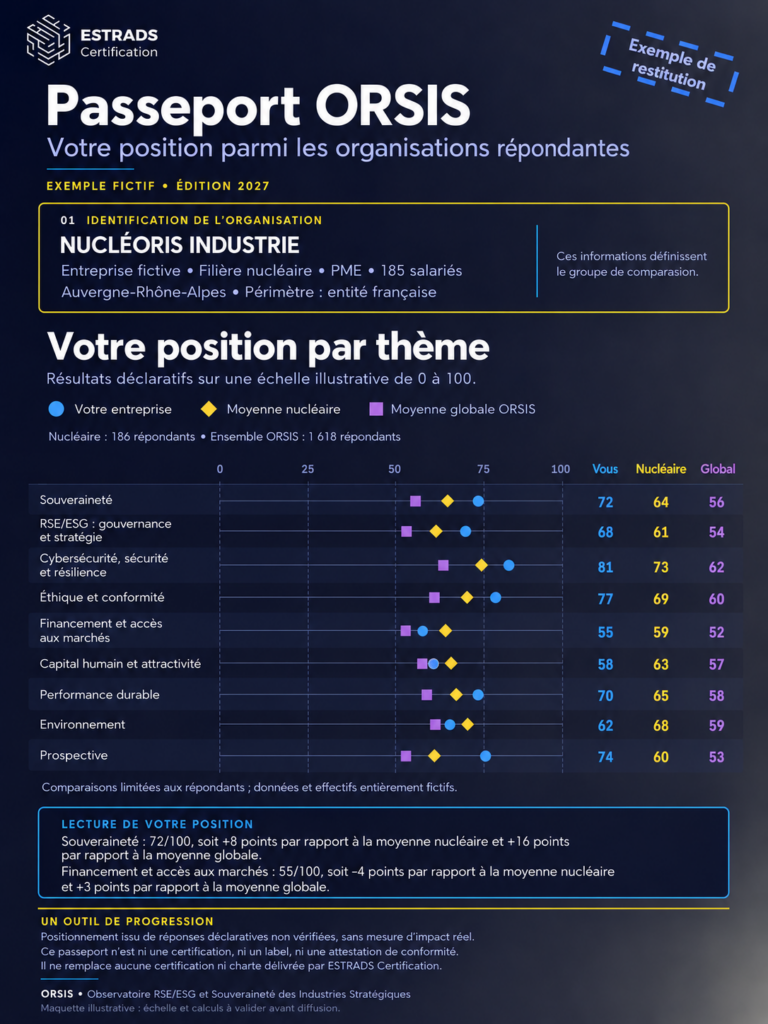
Every company that completes the questionnaire receives its ORSIS Passport free of charge—a personalized report that allows it to compare its reported practices to the average of respondents in its sector and to that of all participating organizations. This comparative analysis helps identify the company’s strengths and areas for improvement and informs its priorities for action. The ORSIS Passport is a decision-making tool: it is neither a certification, nor a label, nor a certificate of compliance, and does not replace any certification or charter issued by ESTRADS Certification. The example below features a completely fictional company and results.
Sovereignty, resilience, and ESG are no longer merely compliance issues. They are becoming factors in competitiveness, market access, and attractiveness.
ORSIS enables organizations to assess their level of preparedness for these challenges and anticipate future expectations.
Why Become an ORSIS Partner?
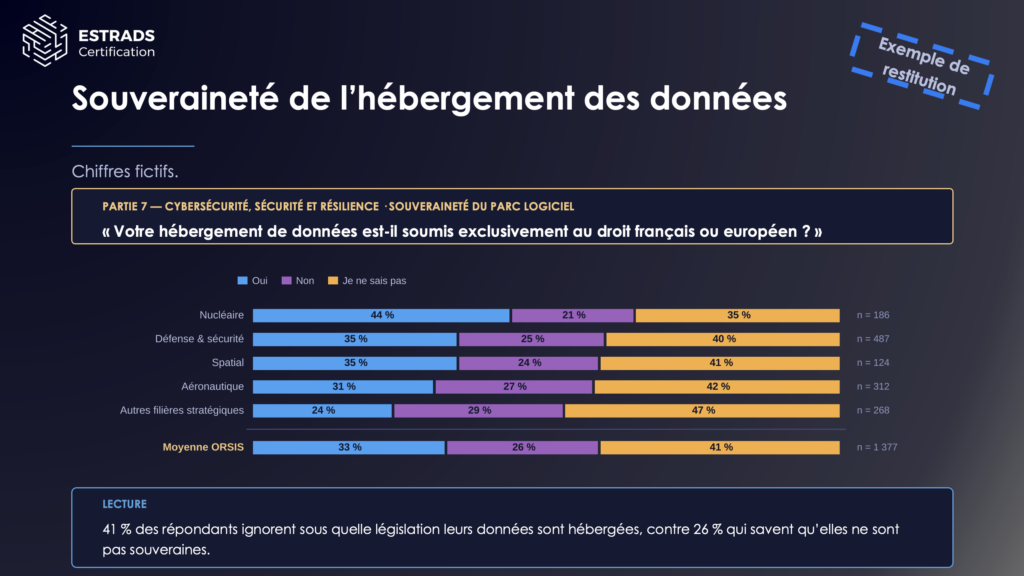
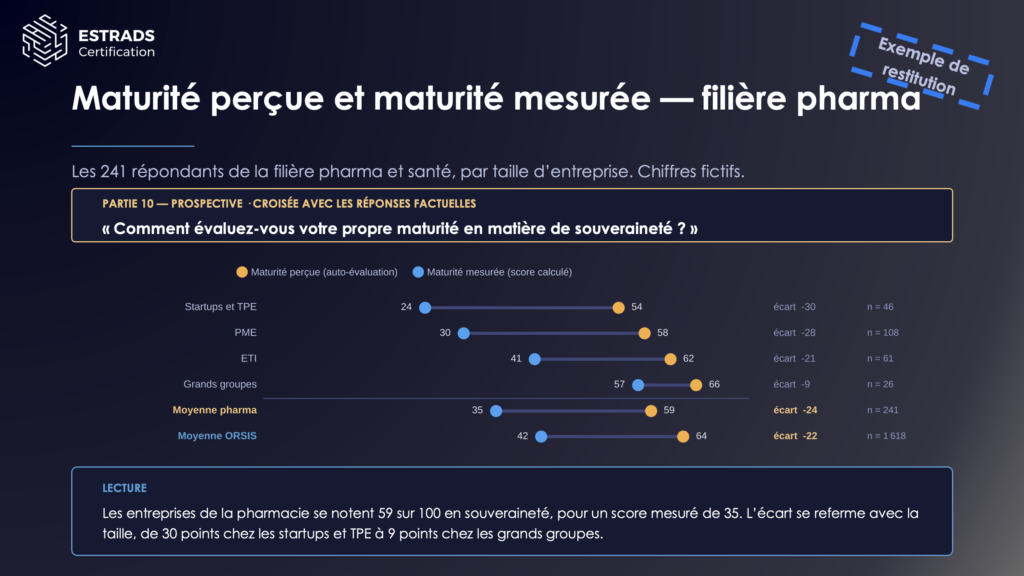
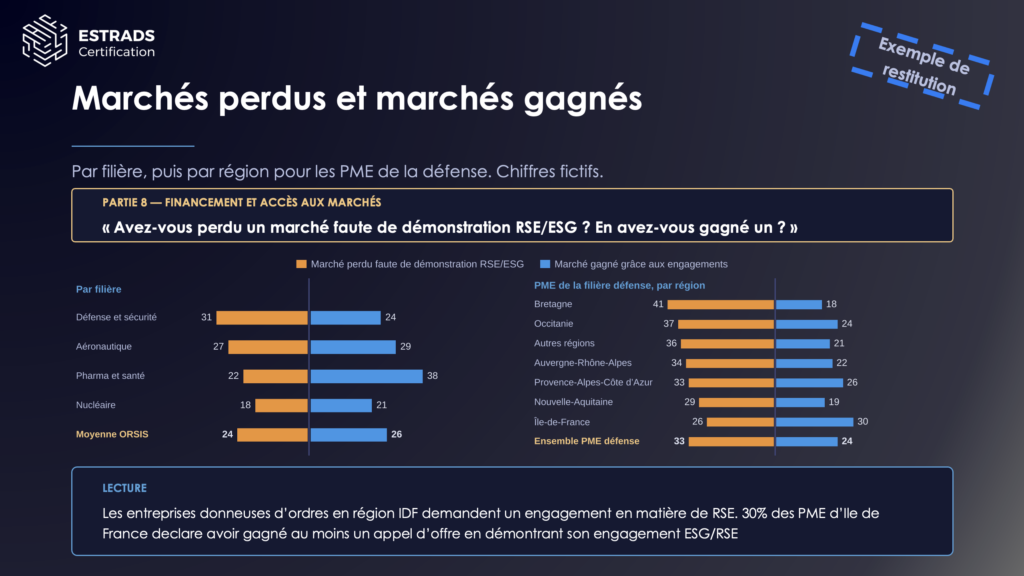
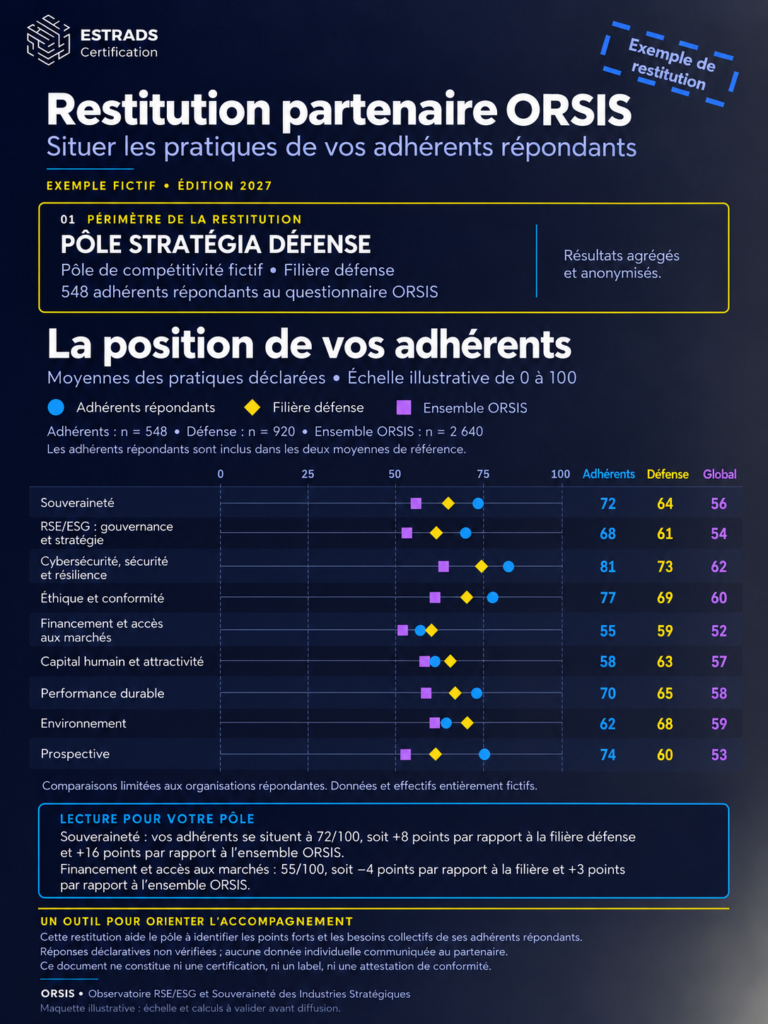
Each partner group, cluster, or hub receives a report on the ORSIS results tailored to its partnership. Based on aggregated and anonymized data, this report allows the group to compare the practices reported by its responding members to the average for their sector and to that of all participating organizations, in order to identify their strengths and areas where support is needed. The scope, content, and format of this report vary depending on the terms of the partnership, with no individual data disclosed. ORSIS’s findings are also presented to several ministries, the CEA, the DGA, the Senate, and the National Assembly. The example below illustrates a report provided to a fictional defense competitiveness cluster, with entirely fictional results.
In a context where non-financial requirements are becoming contractual—such as CSRD, the duty of care, and clients’ ESG —partnering with ESTRADS Certification, an independent trusted third party that provides verification, ESG ratings, CSR certification, and sovereignty assessments, enhances the partner’s own credibility ESG beyond the mere benefit of visibility.
1. Associate your brand with the Leading Observatory on Strategic Sectors
Issues related to ESG, resilience, and economic, industrial, and technological sovereignty now play a central role in public policy, industrial strategies, and investment decisions. However, the available data on strategic sectors remains fragmented, often too general, and rarely tailored to the specific realities of these complex and sensitive sectors.
2. Contribute to a better understanding of strategic sectors
By becoming an ORSIS partner, public institutions, banks, insurance companies, investment funds, competitiveness clusters, professional federations, chambers of commerce, clusters, research organizations, and professional associations help create a unique knowledge tool that enables:
- to identify changes in practices ESG ;
- to observe the dynamics of industrial and technological sovereignty;
- to assess resilience challenges in value chains;
- to anticipate the future needs of strategic companies;
- to better target assistance and support efforts for the various sectors.
This knowledge benefits each type of partner in different ways:
- For a federation or cluster, it is a tool for gaining industry insights that can be made available to its members.
- For a government, this provides strategic insight into the resilience ESG and sovereignty of its industrial base, gathered by an independent third party capable of eliciting candid responses in situations where a survey conducted directly by the government would elicit greater caution.
- For a financial partner, this involves a nuanced and forward-looking assessment of a sector’s needs and priorities, which can inform its own development strategy—without ever having access to respondents’ personally identifiable information.
3. Showcase their commitment to economic stakeholders
The support provided to ORSIS enables partners to:
- to reaffirm their commitment to the responsible development of strategic sectors;
- to demonstrate their commitment to issues of national and European sovereignty;
- to increase their visibility among public and private decision-makers.
In particular, partners benefit from:
- visibility in communication materials and at presentation events, among decision-makers in high-stakes sectors such as defense, security, aerospace, and nuclear energy;
- privileged access to the results;
- participating in strategic discussions on the observatory’s future direction, as part of the Steering Committee;
- Sector exclusivity ensures that we are the sole financial partner of choice in a given industry, a direct competitive advantage over any other player seeking to partner with the same barometer in the same sector.
The Steering Committee ORSIS
To ensure the relevance of its work and maintain a constant connection with the realities of strategic industries, the Observatory for the ESG , and Sovereignty of Strategic Industries (ORSIS) relies on a Steering Committee comprising representatives from professional and ministerial organizations, federations, associations, clusters, institutions, companies, and qualified experts.
The Steering Committee serves as a forum for discussion and reflection, enriching the observatory’s work through the diversity of experiences and expertise represented. In particular, it helps identify emerging challenges in strategic sectors, convey the concerns of stakeholders on the ground, propose new research topics, share regulatory and sector-specific developments, and improve the ORSIS questionnaire each year. This collaborative approach brings together the perspectives of manufacturers, small and medium-sized enterprises (SMEs) and mid-sized companies, platforms and infrastructure providers, trade associations, research organizations, public institutions, and experts on issues related t ESG , and sovereignty. This diversity ensures a nuanced understanding of the challenges faced by strategic French and European organizations and guarantees that the Observatory’s questionnaire and research themes remain grounded in on-the-ground realities, edition after edition.
This openness to stakeholders in the relevant sectors is accompanied by a strict separation between governance and methodological responsibility. The Steering Committee does not intervene in either the data analysis or the observatory’s conclusions. All methodological work, statistical processing, analyses, publications, and position statements remain the exclusive responsibility ofESTRADS Certification, an independent, trusted third party. This structure ensures a balance between openness to industry stakeholders, the quality of dialogue, analytical independence, methodological consistency, and the sustainability of the work.
The ORSIS Steering Committee comprises three categories of members: institutional members (ministries, public agencies, chambers of commerce), industry members (federations, clusters, professional associations, and other associations), and expert members (banks, insurers, specialized firms, academics, and research centers).

Privacy and Data Protection
ESTRADS Certification is committed to ensuring the strict confidentiality of the information collected through ORSIS.
Individual data (ORSIS Passport) is used solely to generate the participant’s personalized report and is not disclosed to any external parties.
Public reports, press releases, studies, and presentations produced by ORSIS are based exclusively on consolidated, aggregated, and anonymized data, which under no circumstances allow for the identification of a participating organization or the association of a result with a specific company.
No individual information may be published, disseminated, or transmitted to a third party without the prior written consent of the organization concerned.
ORSIS is not intended to publicly evaluate companies, but rather to measure trends in strategic sectors and to provide each participant with a tool to aid in decision-making and progress.