Certification and Charter Levels
ESTRADS Certification ’s certification levels indicate where an organization stands in its “ ESG ” or “sovereignty” initiative. The results are expressed differently depending on the program: five levels for certifications ESG, a score out of 100 for the NSI, and three levels—Bronze, Silver, or Gold—for the charters.
The Five Certification Levels ESG
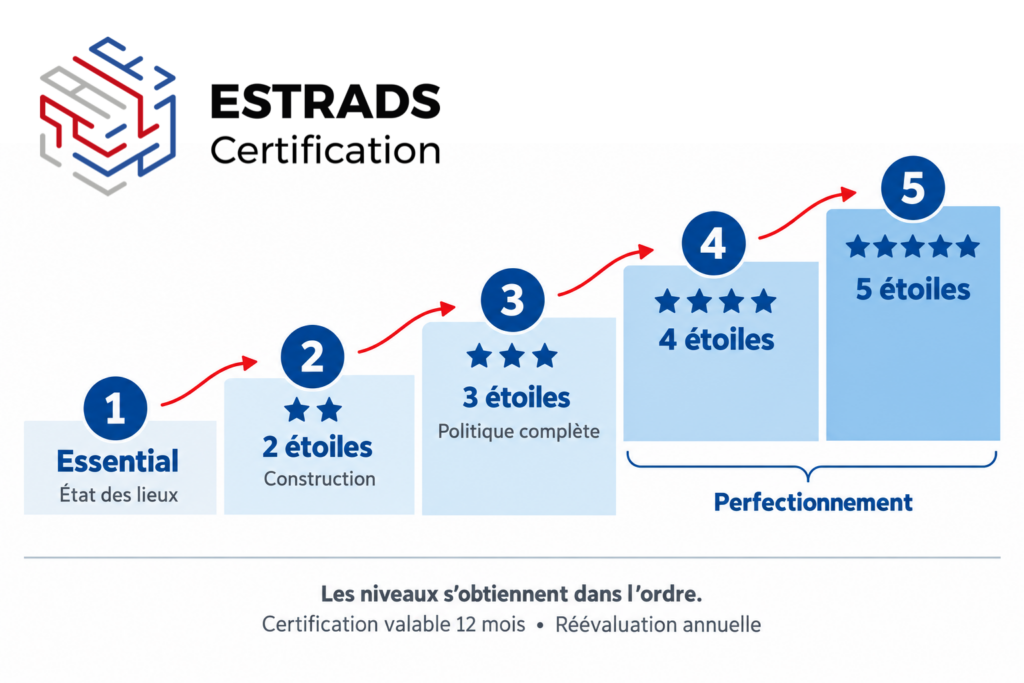
Level 1, Essential: The Current Situation
The organization completes the first-level questionnaire, either on its own or with the help of the team atESTRADS Certification. Its responses and supporting documents highlight what is already in place: its strengths, its weaknesses, what needs to be corrected quickly, and what will take more time.
The Essential level recognizes an organization that is aware of its ethical, social, and environmental responsibilities, applies the fundamentals, and is formally committed to making progress. The analysis report provided at this stage serves as a roadmap for the organization.
2-Star Level: Construction
The 2-star level focuses on achievements. The organization implements, completes, or improves the measures that were missing from its policy ESG. To achieve this level, it must submit, at a minimum, evidence showing that work has begun on each weakness identified at the previous level, or that such work has been completed.
3-Star Level: A Comprehensive Policy
The 3-star level evaluates the “ ESG ” policy as a whole. It must be comprehensive, consistent, and implemented on a daily basis. The organization submits a complete dossier demonstrating compliance, and the “ESTRADS Certification ” report identifies the remaining issues that need to be addressed.
4- and 5-star levels: advanced training
The 4- and 5-star levels are intended for organizations whose “ ESG ” policy is already comprehensive and fully implemented. To achieve these levels, they go beyond what is required: new initiatives, more ambitious commitments, and lasting results. At each evaluation, ESTRADS Certification provides them with suggestions for improvement. These levels are reserved for organizations that serve as role models in their sector.
The Rules for Advancement
- The levels are earned in order: you must complete one level before moving on to the next. However, an organization that is already at an advanced stage can progress quickly.
- The criteria are tailored to the sector, size, and type of organization: manufacturing, services, consulting, startups, nonprofit organizations, military facilities, and airport hubs. A startup is not evaluated in the same way as a large corporation.
- A certification is valid for 12 months. Each year, an evaluation allows an organization to maintain its current level or advance to the next one. An organization that no longer meets the requirements for its current level—often following a takeover or a change in leadership—may be downgraded by one level.
- The certified organizations and their certification levels are listed on the [Our References] page.
The NSI Sovereignty Index, ranging from 0 to 100
The NSI (National Sovereignty Index) certification does not have different levels. It provides a sovereignty index expressed as a percentage, ranging from 0 to 100, calculated based on more than 200 criteria tailored to the type of organization. There is no minimum threshold: every organization that is evaluated is certified, with the index it has achieved.
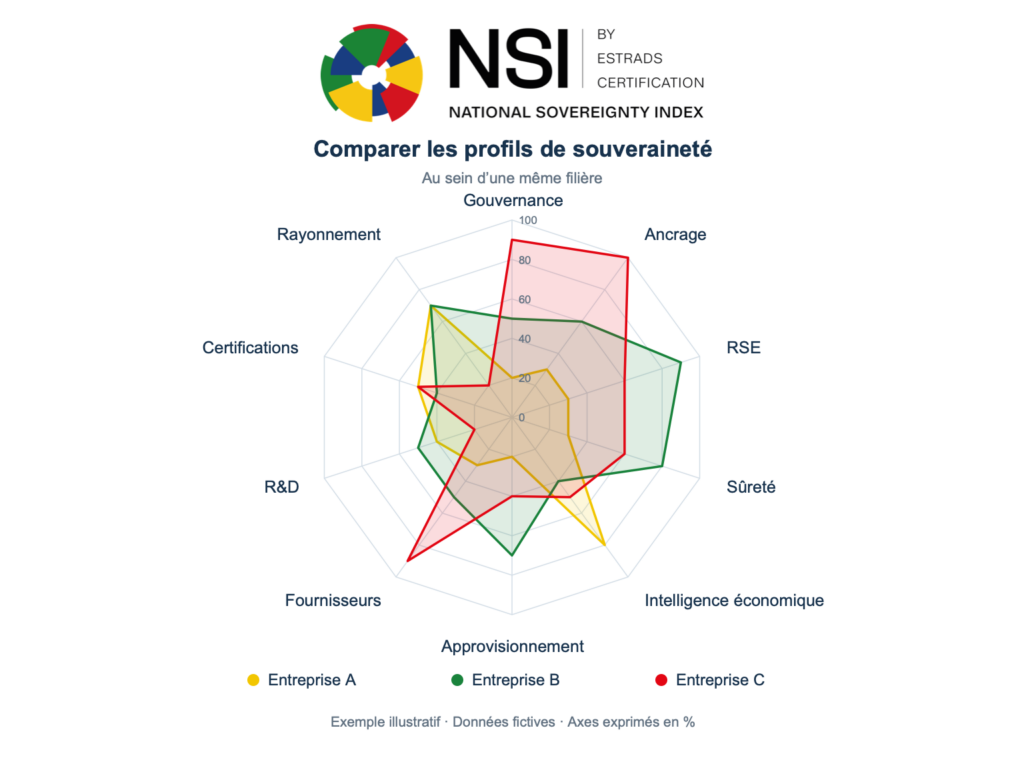
The overall index is accompanied by a score for each topic evaluated:
- company signage;
- governance;
- geographic roots;
- sustainable development and ESG ;
- safety;
- economic intelligence;
- supply of raw materials and intermediate goods;
- selection and management of suppliers and subcontractors;
- research and development;
- certifications received;
- radiation.
This allows the organization to identify where its dependencies lie—whether financial, digital, technological, or industrial—and in which areas it can improve its score.
A country-specific or European index
The index can be calculated for a reference country, for several countries, or at the European level. The calculation takes into account criteria specific to each country: for example, a company might score 85% in France and 73% in Italy.
The index is valid for 12 months and is recalculated annually. An organization that reduces its dependencies sees its index improve.
ESTRADS Certification publishes its own NSI index—90.52%—along with a breakdown of the calculation, on the [Our Sovereignty] page.
The three levels of the charters: Bronze, Silver, Gold
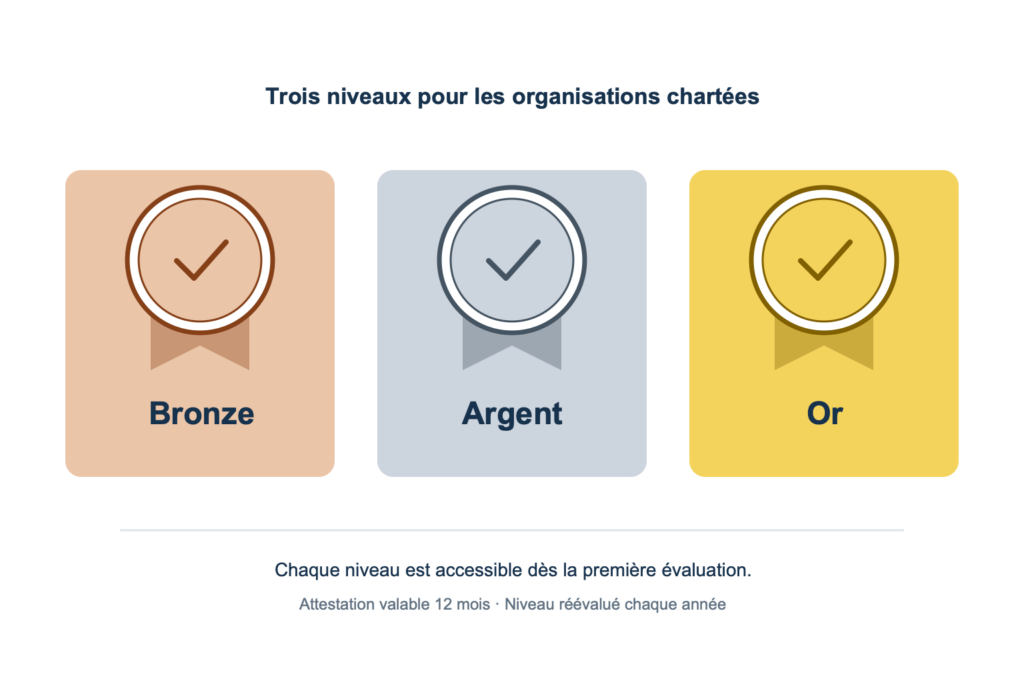
The CDOFAC (civil aviation training organizations), CDOMAC (civil aviation maintenance organizations), and CeeRSE (companies in all sectors) charters have three levels: Bronze, Silver, and Gold. These medals are reserved for the charters.
A charter is less rigorous than a certification. The signatory commits to a code of conduct specific to their profession and meets more than 100 criteria. ESTRADS Certification verifies the signatory’s responses based on the documents and certificates provided, then assigns a level corresponding to their results. The signatory receives a certificate, without a detailed analysis report.
On-site inspections are routine for gold
For the Bronze and Silver levels, ESTRADS Certification conducts random on-site inspections. For the Gold level, on-site inspections are conducted systematically.
A level reviewed annually
The certificate is valid for 12 months. The level depends on the results of that year’s evaluation: it may go up or down from one year to the next. Unlike certifications, the levels under a charter are not obtained in order: a signatory can achieve the Gold level as early as their first evaluation.
Each signatory displays a sign summarizing the main points of the charter, along with a QR code. Students, customers, or employees can use it to send feedback—whether positive or negative—regarding compliance with the charter to ESTRADS Certification .
How do I earn a level?
The certification process and the charter process are described step by step on the [link: The Certification Process] page. To find out which certification or charter is right for your organization, visit [link: Our Certifications] or contact the team atESTRADS Certification.
Buttons: “View the certification process” and “Contact us.”